
In summary
- Video surveillance is processing of personal data. It requires signage, conservation periods and access control.
- More cameras isn't a better system. A few well-placed cameras are worth more than many poorly aimed ones.
- The chambers must be in segmented network — never on the same network as the workstations.
- Never expose the recorder directly to the internet. It is one of the most exploited targets in existence.
In this article
For many companies, video surveillance is the only technical system bought from a catalogue. A number of cameras are chosen, installation is contracted, and only later is it discovered that the footage is no good for what was needed — or that the system has become the most vulnerable point on the network.
Start with the objective
Before counting rooms, answer a question: What is this system used for? The possible answers lead to different projects.
Deterrence demands visible cameras at checkpoints — this can be achieved with a few well-positioned pieces of equipment.
Identification of individuals it requires very specific resolution and framing, typically at head height at entry points. A panoramic camera of an entire warehouse will never identify anyone, no matter how many megapixels it has.
Process check — loading, dispatch and packing areas — requires angles that show the operation and not just the space.
Evidence in the event of a claim it demands, above all, sufficient retention periods and usefully exportable images.
The most expensive mistake: installing panoramic cameras everywhere and finding out, when it's needed, that you can't make anyone out. Two cameras properly aimed at the entrances are worth more than ten covering empty space.

What defines a good project
Three variables determine whether the images will be suitable: context, lighting e conservation.
Framing is decided on-site, not on the blueprint — a camera pointed towards a window produces useless silhouettes in the middle of the afternoon, and you only realise that by being there.
Lighting is what separates a usable image from a blur. Outdoor areas, car parks and loading bays require equipment suited to low light, and the difference in quality between ranges becomes apparent precisely when the footage is needed.
Conservation defines storage sizing. How many days do you need to keep? That answer, multiplied by the number of cameras and the quality, gives the necessary space — and this is where many systems fall short, deleting the exact period that mattered.
The part nobody sees: the network
IP cameras are computers connected to the company network, and that is where poorly executed projects create lasting problems.
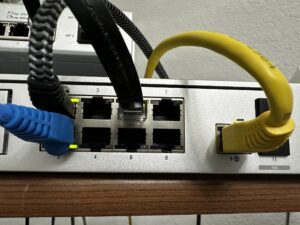
They need proper cabling — go through the same thing structured network from the rest of the company and are powered by the cable itself, which requires switches with sufficient capacity. Adding cameras to a switch without power headroom is a recipe for random reboots that are difficult to diagnose.
And they need segmentation. Cameras must live on a separate network from workstations and servers. Two reasons: video traffic is continuous and heavy, and CCTV equipment is historically among the least updated. A compromised camera on a flat network gives access to everything else.
System security
CCTV systems are among the most sought-after equipment by anyone scouring the internet for easy targets. Four measures prevent the overwhelming majority of problems:
- Change the factory credentials on all equipment, including the cameras and not just the recorder.
- Never connect the recorder directly to the internet. Remote access must be via VPN or the manufacturer's platform with strong authentication — never by port forwarding.
- Update the firmware. It rarely happens, and it's where known vulnerability fixes are.
- Restrict who has access, with named accounts instead of a shared one, and access logging.
Legal obligations
Video surveillance in a business context is processing of personal data and has specific obligations. Without entering into legal territory, there are points that any company must have covered:
- Visible signage notifying about the existence of the system, prior to the monitored zones.
- Defined retention period and effectively applied — keeping it indefinitely is not an option.
- Withdrawal limitsrest areas, changing rooms and spaces with an expectation of privacy are out.
- Image access control, with a log of who consulted what.
- Treatment record in the company's data protection documentation.
There are also specificities when the system covers employee workstations, which must be validated with legal advice — the purpose cannot be the monitoring of workers' performance.
DataRoad designs and installs integrated IP video surveillance systems in structured network of the company, with segmentation, secure remote access and perimeter protection appropriate.
A chat before making a decision
Whether you’re tackling a specific problem, planning a move or simply looking for a second opinion, we always start in the same way: by understanding your situation before making any suggestions. No obligation, no jargon and no catalogues.
DataRoad Blog Articles
- Harland & Poston: network, firewall and Wi-Fi on Av. da Liberdade
- Cisco Meraki: MX95 firewall, switches and wireless coverage
- Company Wi-Fi Security: Guests, Passwords and What You Should Never Share
- Klass Wagen: network, Wi-Fi, firewall and video surveillance in Funchal